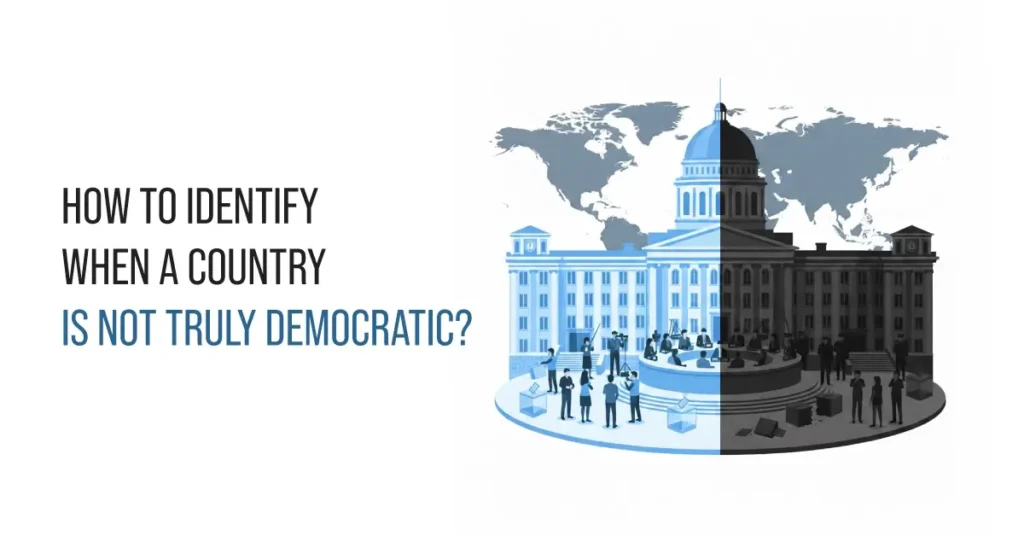
How to Identify when a Country Is Not Truly Democratic?
Democracy is often described as “government of the people, by the people, for the people.” But in reality, many countries today only carry the label of democracy without practicing its true principles. Political scientists argue that while elections are held, institutions exist, and leaders claim legitimacy, the actual system may function more like authoritarianism.
This article explores the key signs of democratic decline, supported by examples, data, and expert insights. By the end, you’ll be able to recognize when a country is democratic in name only.
Table of Contents
Questionable Elections – The Heart of Democracy
Free and fair elections are the lifeblood of democracy. If elections are manipulated, democracy collapses.
Signs of questionable elections include:
- Widespread vote rigging and ballot stuffing
- Disqualification of opposition candidates
- Media bias during campaigns
- Intimidation of voters
| Country Example | Issue in Elections | Outcome |
|---|---|---|
| Russia | Opposition leaders barred | Ruling party dominance |
| Zimbabwe | Ballot manipulation | Low voter trust |
| Myanmar | Military interference | Democracy collapse |
Dictators Also Hold Elections
Authoritarian leaders often organize elections to legitimize their rule. These elections are carefully controlled to ensure victory.
Example: In many African and Asian states, leaders win with 90%+ of votes, raising suspicion about fairness.
Brian Klaas (London School of Economics) explains:
Most dictators don’t cancel elections; they rig them to appear democratic.
Suppression of Public Opinion
In a democracy, citizens can freely criticize the government. In authoritarian systems, dissent is silenced.
Methods of suppression:
- Arresting activists and journalists
- Banning protests
- Using violence against demonstrators
Declining Voter Participation
When people lose faith in elections, voter turnout drops.
Indicators:
- Citizens believe their votes don’t matter
- Low turnout despite heavy campaigning
- Youth disengagement from politics
One-Party Parliament
A healthy democracy requires opposition voices. When parliament becomes dominated by one party, checks and balances disappear.
Example:
- North Korea: 100% one-party parliament
- Turkey: Opposition weakened through legal and political pressure
Security Forces Misused
In non-democratic states, the police and military are used to protect rulers, not citizens.
Signs:
- Security forces suppress protests
- Arbitrary arrests of opposition leaders
- Military involvement in politics
Weak Institutions
Strong institutions like the judiciary, the election commission, and the parliament are essential for democracy.
If institutions are weak:
- Courts favor ruling elites
- Election commissions lack independence
- Parliaments rubber-stamp government decisions
Example: In Venezuela, the Supreme Court consistently rules in favor of the government, undermining judicial independence.
Fear of Free Speech
Without democracy, citizens fear expressing opinions.
Indicators:
- Journalists face censorship
- The Internet is restricted
- Citizens avoid political discussions
Rising Corruption
Authoritarian regimes thrive on corruption. Loyalty to the ruler is rewarded with opportunities for wealth.
How corruption works:
- Loyalists get contracts and privileges
- Opponents are punished with corruption charges
- Wealth is concentrated among elites
Example: In Nigeria, corruption scandals involving billions of dollars have weakened democratic trust.
Fear of Losing Power
Dictators fear retirement because they risk revenge from rivals. This insecurity makes them cling to power indefinitely.
Example: Uganda’s Yoweri Museveni has ruled since 1986, constantly changing laws to stay in power.
Comparative Table: Democracy vs. Authoritarianism
| Feature | True Democracy | Fake Democracy / Authoritarianism |
|---|---|---|
| Elections | Free, fair, competitive | Rigged, manipulated |
| Institutions | Independent | Politically controlled |
| Media | Free press | Censored |
| Security Forces | Protect citizens | Suppress dissent |
| Corruption | Limited, punished | Institutionalized |
| Voter Turnout | High | Low |
| Parliament | Multi-party | One-party |
Frequently Asked Questions
Can a country have elections but not be democratic?
Why do dictators fear losing power?
What role does corruption play in weakening democracy?
How can citizens identify democratic decline?
Which institutions are most critical for democracy?
Conclusion
Democracy is more than elections—it requires freedom of speech, strong institutions, fair competition, and accountability. When these elements weaken, democracy becomes a façade. Recognizing these signs helps citizens, researchers, and policymakers protect democratic values worldwide.
Education and technology are deeply connected to democracy. To explore how Artificial Intelligence is transforming classrooms and shaping future citizens, read our article on The Growing Role of Artificial Intelligence in Modern Education.