Co-operation, Not Individualism: The Heart of Scientific Management Theory
Imagine a workplace where everyone rows the boat in the same direction. There is no infighting, no hiding information, and no working against each other. Instead, management and workers sit at the same table, share the same goals, and build success together.
This is not just a modern dream. It is a core business idea that started over a century ago. It is called Co-operation, Not Individualism, and it is one of the most powerful concepts in modern business.
In this complete guide, we will explore this essential concept. We will break down what it means, look at the history behind it, and show you exactly how to use it to boost team productivity and organizational harmony today.
Table of Contents
Introduction to Scientific Management Theory
To understand cooperation, we first need to look at the big picture. In the early 1900s, an engineer named Frederick Winslow Taylor changed how the world worked. He created what we now call Scientific Management Theory.
Before Taylor, workplaces were chaotic. Managers guessed how long tasks should take. Workers did things their own way. There was no standard system, and there was a lot of conflict. Taylor wanted to fix this. He believed that management and workers should act as friends, not enemies.
He developed four main management principles to guide businesses. These rules transformed factories and offices around the world.
The Four Core Principles
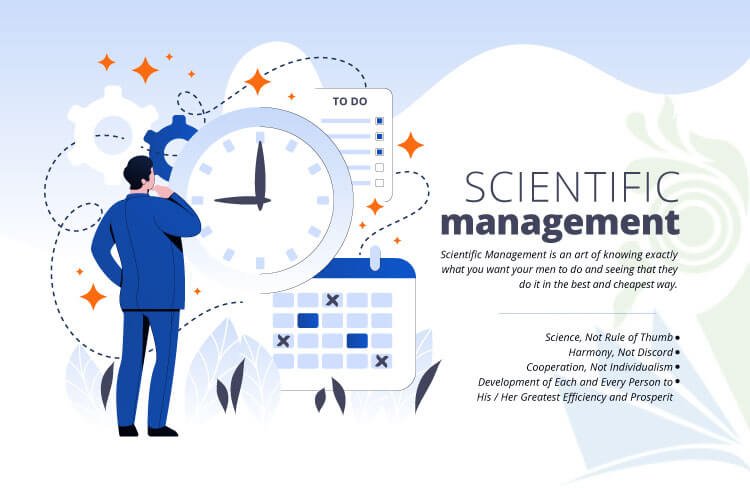
- Science, Not Rule of Thumb: Instead of guessing how to do a job, managers should study the work. They should find the one best, most efficient way to complete a task using data and science.
- Harmony, Not Discord: The workplace should be peaceful. Managers and workers should build strong relationships and eliminate conflicts that slow down progress.
- Co-operation, Not Individualism: This is the natural next step after harmony. It means working together as a unified team rather than focusing only on personal success. We will dive deep into this principle below.
- Maximum, Not Restricted Output: Instead of workers slowing down to protect their jobs (a practice called “soldiering”), both sides should focus on producing as much as possible. More output means more profit, which leads to higher wages for everyone.
Understanding these four pillars is the first step in learning How to apply Scientific Management in the Modern Workplace? Today, we are going to shine a spotlight on the third principle, because teamwork is more important now than ever before.

Historical Background: The Birth of a New Workplace
The Pre-Industrial Mindset
Before the 1900s, the relationship between a boss and an employee was very cold. Bosses gave orders. Workers followed them. If a worker found a faster way to do something, they often kept it a secret. Why? Because if they worked faster, the boss might lower their pay rate or expect more work for the same money.
This created a culture of deep individualism. It was “every man for himself.” Workers looked out for their own safety, and bosses looked out for their own profits. This lack of trust ruined team productivity.
Frederick Taylor’s Breakthrough
Frederick Taylor saw this problem firsthand while working at the Midvale Steel Company. He noticed that the company was losing money and the workers were unhappy and tired.
Taylor realized that individualism was the root cause of the failure. As long as managers and workers treated each other like opponents, the business would never reach its full potential. He introduced a radical idea for his time: Management and workers must share the responsibility of work.
Taylor argued that managers should step in and help workers. They should plan the work, provide the right tools, and offer training. In return, workers should execute the plan with a cooperative spirit. By working together, they could bake a larger pie, meaning more profits for the company and higher wages for the workers.
Understanding of Co-operation, Not Individualism
What does “Co-operation, Not Individualism” really mean in practice? Let us break it down into simple terms.
The Shift from “Me” to “We”
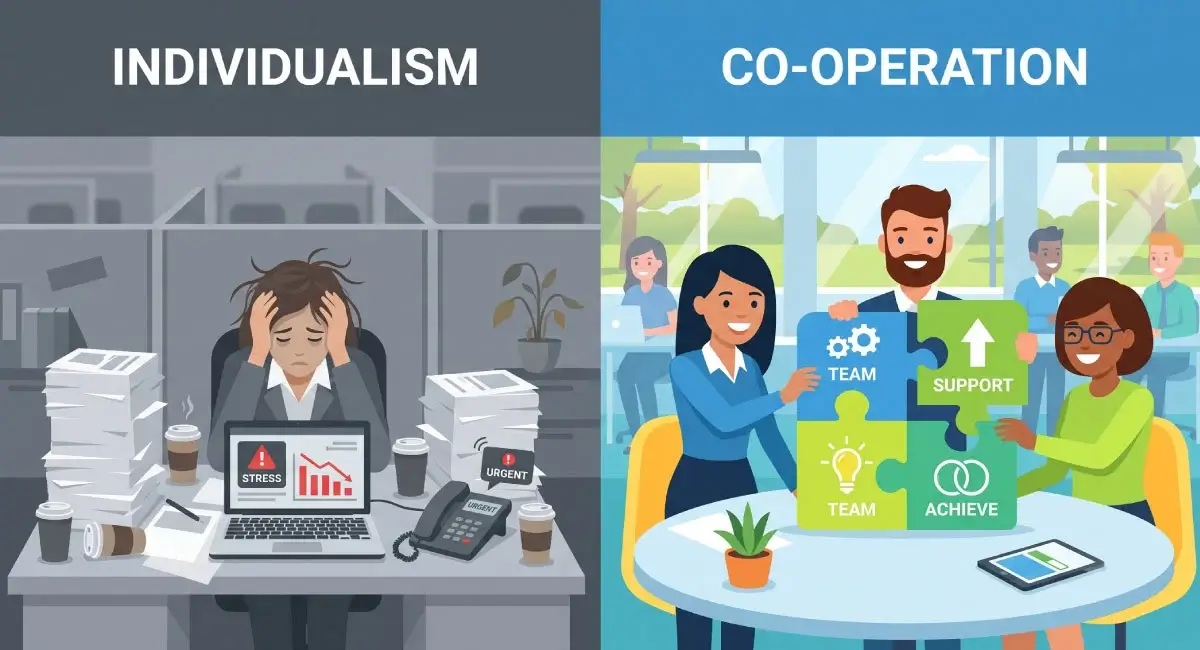
Individualism says, “I will do my job, you do yours, and let us not bother each other.” Cooperation says, “How can we do this job better together?”
Under this principle of Scientific Management Theory, the success of the business is a shared goal. The manager is no longer a dictator who simply shouts orders. Instead, the manager becomes a coach, a planner, and a supporter. The worker is no longer just a pair of hands. The worker is a valued team member who brings the plan to life.
Shared Responsibilities
A huge part of this principle is how work is divided. In an individualistic workplace, the worker does all the heavy lifting—both the physical work and the mental stress of figuring out how to do it.
Co-operation splits this burden.
- The Managers: Take over the planning, analyzing, and organizing. They clear away roadblocks so the workers can focus.
- The Workers: Focus entirely on doing the task efficiently, knowing they have the full support of their leaders.
Open Communication
For cooperation to work, communication must flow freely. If a worker spots a problem on the assembly line or in a software code, they must feel safe telling their manager. In a cooperative environment, the manager thanks the worker for speaking up, rather than punishing them for finding a flaw. This builds immense organizational harmony.
Data-Driven Insights: Why Co-operation Wins
You might be wondering, “Does this 100-year-old idea still work?” The answer is a massive yes. Modern research proves that workplace cooperation is the ultimate driver of business success. Here is what the data says.
Higher Team Productivity
When people work together, they get more done. A famous study by Stanford University found that people who were treated as part of a team worked 50% longer on difficult tasks than people who worked alone. They also reported feeling more motivated and less tired.
Better Employee Retention
People do not want to leave a company where they feel supported. According to a report by Gallup, highly engaged and cooperative teams show a 59% lower turnover rate. When managers and workers cooperate, workers feel valued. Valued employees stay.
Increased Profitability
Cooperation is not just about making people feel good; it is about the bottom line. Research from McKinsey & Company shows that teams with strong, connected, and cooperative networks are up to 25% more productive. Furthermore, organizations that promote collaborative working are five times more likely to be high performing.
Faster Problem Solving
When individualism rules, problems are hidden. When cooperation rules, problems are solved. A study by the Harvard Business Review noted that collaborative teams solve complex problems much faster because they combine different skills and viewpoints.
The Battle of Mindsets: Individualism vs. Co-operation
To truly understand the power of this management principle, we need to compare it directly to the old way of doing things.
Here is a simple table that shows what happens when a company chooses cooperation over individualism.
| Feature | The Individualism Mindset | The Co-operation Mindset |
| Focus | Personal success and survival. | Team success and shared goals. |
| Problem Solving | Blame others when things go wrong. | Fix the root cause of the problem together. |
| Information | Kept secret to maintain personal power. | Shared freely to help the whole team. |
| Manager’s Role | Dictator who gives orders and punishes. | Coach who guides, plans, and supports. |
| Worker’s Role | Just a pair of hands following rules blindly. | An active partner in executing the vision. |
| Output Level | Restricted (workers do the bare minimum). | Maximum (workers are motivated to excel). |
| Workplace Vibe | High stress, suspicion, and discord. | High trust, support, and harmony. |
As you can see, the cooperative mindset creates a much healthier and more profitable environment. It eliminates the friction that slows businesses down.
Case Studies: Companies Mastering Co-operation
The best way to understand “Co-operation, Not Individualism” is to look at real companies. Many of the most successful businesses in the world use this exact principle to stay on top. Let us look at three amazing examples.
1. Toyota: The Power of the Andon Cord
Toyota is famous for its incredible manufacturing process, often called the Toyota Production System. At the heart of this system is deep cooperation between management and factory workers.
Toyota uses a tool called the Andon cord. It is a literal rope hanging above the assembly line. If any worker, at any time, sees a problem, a defect, or a safety issue, they are encouraged to pull the cord. Pulling the cord stops the entire production line.
In an individualistic company, stopping the line would get a worker fired. But at Toyota, when a worker pulls the cord, a manager runs over to thank them. The manager and the worker then cooperate to fix the problem immediately so it never happens again. Management trusts the workers, and workers trust management. This cooperation is why Toyota builds some of the most reliable cars on earth.
2. Google: Project Aristotle
A few years ago, Google wanted to know what made their best teams so successful. They launched a massive research study called Project Aristotle. They looked at data from hundreds of teams to find the secret formula.
Did the best teams have the smartest individuals? No. Did they have the most experienced managers? No.
Google found that the most productive teams had one main thing in common: Psychological Safety. This means team members felt safe to share ideas, admit mistakes, and take risks without fear of being punished. This is the exact modern definition of Taylor’s “Co-operation, Not Individualism.” When Google’s teams moved away from individual egos and embraced a cooperative, safe environment, their innovation skyrocketed.
3. A Modern E-Commerce Fulfillment Center
Let us look at a modern warehouse that ships online orders. In the past, managers sat in glass offices while workers ran around packing boxes. Workers were penalized if they moved too slowly.
Today, successful e-commerce brands use cooperative management. Managers use software to track data (Science, Not Rule of Thumb). They notice that a certain aisle is causing workers to slow down. Instead of yelling at the workers, the managers walk down to the floor. They ask the workers, “What is slowing you down here?”
The workers explain that the heavy boxes are on the top shelf, making it hard to reach them safely. Management and workers cooperate to redesign the aisle. They move heavy boxes to waist height. Team productivity goes up, and worker injuries go down. This is Scientific Management Theory in action.
Modern Tools and Frameworks to Support Cooperative Management
Frederick Taylor used stopwatches, clipboards, and paper charts to build cooperation. Today, we have incredible technology and modern frameworks that make it easier than ever to bring this principle to life.
Agile and Scrum Frameworks
In the software and marketing worlds, Agile and Scrum are incredibly popular. These are project management frameworks built entirely on cooperation.
- Instead of a manager giving a team a one-year deadline and walking away, Agile teams work in short bursts called “sprints.”
- Every morning, the team has a 15-minute “stand-up” meeting. They ask each other: What did you do yesterday? What are you doing today? What is blocking your progress?
- Managers (called Scrum Masters) exist purely to remove those roadblocks. It is the ultimate example of management and workers supporting each other.
Digital Collaboration Software
You cannot have cooperation without good communication. Today’s software tools break down walls and eliminate individualism.
- Communication Platforms (Slack, Microsoft Teams): These allow instant, transparent communication. Instead of hiding information in private emails, teams talk in open channels where everyone can contribute.
- Project Management Tools (Asana, Trello, Monday.com): These tools let everyone see what the rest of the team is doing. A worker can see how their specific task helps the larger company goal. This shared visibility builds a massive sense of unity.
- Cloud Documents (Google Workspace, Notion): Multiple people can type in the same document at the same time. The work becomes a shared effort, not an individual chore.
Benefits and Challenges of Applying This Principle Today
While “Co-operation, Not Individualism” is a highly positive concept, applying it in the real world comes with both amazing benefits and a few hurdles.
The Benefits
- Massive Innovation: When people stop worrying about protecting their own egos, they start sharing wild, creative ideas. This leads to new products and better services.
- Higher Morale and Happiness: Humans are social creatures. We like to feel like we belong to a tribe. A cooperative workplace feels like a community, which deeply improves mental health and job satisfaction.
- Faster Crisis Management: When a disaster hits (like a market crash or a supply chain issue), an individualistic company shatters as everyone points fingers. A cooperative company forms a circle, looks at the problem together, and solves it fast.
- Equal Division of Labor: Because management takes on the burden of planning and strategy, workers do not feel abandoned. The workload feels fair and balanced.
The Challenges (How to Overcome Them)
- The Free-Rider Problem: Sometimes, in a highly cooperative team, one individual might stop working hard, expecting the rest of the team to carry them.
- Solution: Clear, individual metrics combined with team goals ensure everyone does their fair share.
- Groupthink: If a team is too focused on harmony, they might stop challenging each other’s ideas. They might agree on a bad plan just to avoid an argument.
- Solution: Encourage healthy, respectful debate. Remind the team that disagreeing on an idea is not the same as attacking a person.
- Time-Consuming Decisions: Getting everyone to cooperate and agree can take longer than a dictator just shouting an order.
- Solution: Have clear leaders. The team cooperates to find the best ideas, but the leader still holds the authority to make the final, swift decision when necessary.
Practical Strategies for the Modern Workplace
How do you actually build this environment? You cannot just hang a poster that says “Teamwork” and expect things to change. You have to change the way the company operates. Here are practical, actionable strategies to foster cooperation over individualism.
1. Change How You Reward People
If you only give bonuses to the single top salesperson, you are promoting individualism. People will start stealing clients from each other. Instead, create team-based rewards. If the whole department hits a goal, everyone gets a bonus. This instantly forces people to help their struggling teammates because everyone’s success is tied together.
2. Lead by Example from the Top
Management must show cooperation first. If leaders are secretive and competitive with each other, the workers will copy that behavior. Managers should openly share company goals, admit their own mistakes, and ask workers for feedback. Vulnerability from leadership builds trust.
3. Build Cross-Functional Teams
Often, departments become individualistic. Sales fights with Marketing. Design fights with Engineering. To fix this, build cross-functional teams. Put one person from marketing, one from sales, and one from design on a single project. When they have to work together daily, they learn to appreciate each other’s skills.
4. Invest in Continuous Training
Frederick Taylor believed management must actively train workers. Do not just hire someone and leave them alone. Provide regular workshops, mentorship programs, and skill-building sessions. When a company invests money in a worker’s growth, the worker repays the company with loyalty and cooperative effort.
5. Create a “No Blame” Culture
When a mistake happens, do not ask who did it. Ask what went wrong with the system. For example, if an email goes out to clients with a broken link, do not fire the person who clicked send. Instead, look at the process. Why wasn’t there a review step? Fix the process together. This eliminates fear and promotes deep organizational harmony.
Conclusion and Actionable Takeaways
Frederick Taylor’s Scientific Management Theory changed the world by bringing science and structure to the workplace. But out of all his rules, “Co-operation, Not Individualism” remains the most human and the most essential.
A business is not a machine made of isolated, individual parts. It is a living ecosystem. When management and workers stop fighting and start supporting each other, the results are magical. Productivity goes up, stress goes down, and the workplace becomes a community rather than a battlefield.
By replacing the “me” mindset with the “we” mindset, companies can unlock their true potential.
Final Actionable Takeaways for Your Business:
- Assess your current culture: Are your employees hiding mistakes or sharing them openly? Use this as a gauge of your team’s psychological safety.
- Redefine management: Ensure your managers view themselves as coaches and planners, not just dictators who enforce rules.
- Implement team rewards: Shift your incentive structures to reward collective team success rather than just individual milestones.
- Use modern tools: Adopt collaborative software like Slack or Asana to break down communication silos and make work visible to everyone.
- Focus on the system, not the person: When errors happen, cooperate to fix the broken process rather than punishing the individual worker.
When you embrace cooperation, you do more than just improve your bottom line. You build a workplace where people actually want to be. And in today’s fast-paced, highly competitive world, a unified, cooperative team is the absolute ultimate advantage.