Difference Between Developed Countries and Developing Countries
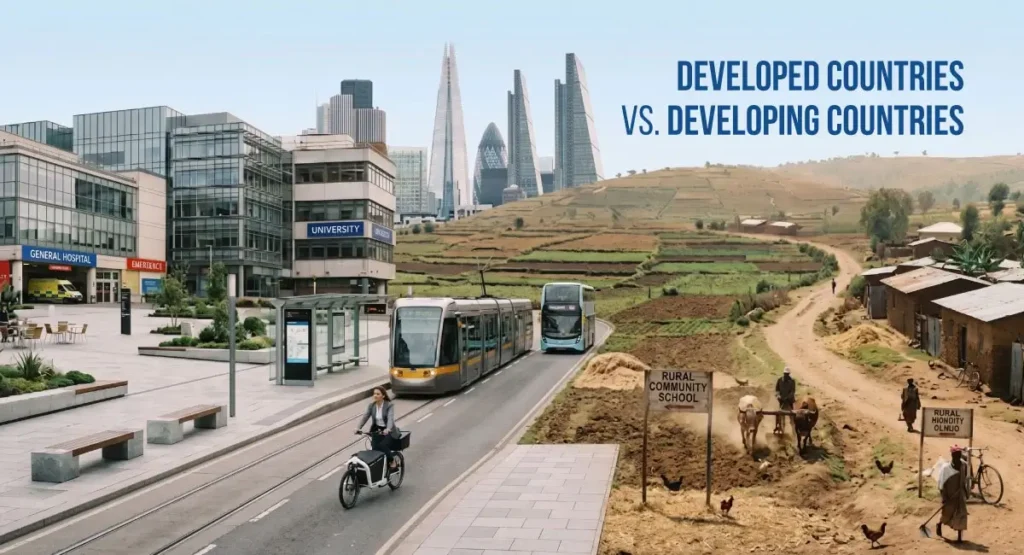
Developed countries are wealthier with better infrastructure, while developing countries are still growing and improving.
The United Nations divides countries into two groups: developed and developing. This depends on things like money, jobs, and how people live.
Developed countries are rich, have modern technology, and provide good jobs, schools, and hospitals. People enjoy a high standard of living.
Developing countries have less money, fewer industries, and lower incomes. They are still growing and working to improve life for their people. To make this easier to understand, we have made a simple table to compare them.
Table of Contents
Comparison between Developed Countries and Developing Countries
Here is a much simpler table comparing Developed Countries and Developing Countries:
| Aspect | Developed Countries | Developing Countries |
|---|---|---|
| Economy | Strong and rich | Weak and low income |
| Industries | Well-developed | Still growing |
| Education | Many good schools | Few schools, many can’t read |
| Healthcare | Good doctors and hospitals | Not many good doctors or hospitals |
| Living | High living standard | Low living standard |
| Infrastructure | Good roads, transport, and services | Poor roads and transport |
| Technology | Advanced technology | Technology is still growing |
| Main Jobs | Mostly in factories and services | Mostly in farming |
| Life Expectancy | People live longer | People live shorter |
| Government Debt | Low debt | High debt |
| Jobs | Low unemployment | High unemployment |
| Poverty | Less poverty | More poverty |
| Baby Deaths | Fewer babies die | More babies die |
Definition of Developed Countries
Developed countries are rich and have strong industries. They are also called advanced or first-world countries because they can take care of themselves.
The Human Development Index (HDI) ranks countries based on how well they are doing. Developed countries have a high quality of life, good jobs, and strong healthcare. They have good schools, transportation, and housing. People in these countries live longer and earn more money.
These countries make more money from factories and businesses than from services.
Some examples of developed countries are: Australia, Canada, France, Germany, Italy, Japan, Norway, Sweden, Switzerland, and the United States.
Definition of Developing Countries
Developing countries are countries that are still growing and have low income. They are also called third world countries.
These countries need help from richer countries to build factories and businesses. They have a low Human Development Index (HDI). This means they have small economies, many people can’t read, and they don’t have good healthcare or schools. Many people are poor, and there are a lot of problems like hunger and high baby death rates.
Some examples of developing countries are: Colombia, India, Kenya, Pakistan, Sri Lanka, Thailand, and Turkey.
Key Differences Between Developed and Developing Countries
Here are the main differences between developed and developing countries:
- Developed countries are rich and stable. Developing countries are still starting to grow.
- Developed countries have high income and GDP, while developing countries have low income and GDP.
- In developed countries, most people can read and write. In developing countries, many people cannot.
- Developed countries have good hospitals, roads, and safety. These are often missing in developing countries.
- Developed countries make money from factories and businesses. Developing countries make money from services like teaching and tourism.
- People in developed countries have a higher quality of life. In developing countries, life is harder.
- Developed countries use resources wisely. Developing countries do not use resources as well.
- In developed countries, the birth and death rates are low. In developing countries, both rates are high.
Read More: Difference between Economic Growth and Economic Development
Some Relevant Information
There are include some important and relevant information by which is required to understand the discussion
Regional Development Differences
In many developing countries, cities grow faster than villages. Cities have better roads, healthcare, and schools. Villages often don’t have these services, which causes problems for the country’s overall growth.
Emerging Middle-Income Countries
Countries like China, Brazil, and India are growing quickly. They are building better roads, improving technology, and growing industries. These countries are getting closer to being developed.
Urban vs. Rural Disparities
In many countries, cities have more development than villages. Cities have better roads, healthcare, and schools. Villages often lack these things, which makes it harder for the country to grow evenly.
Read More: Public Sector Reform in Developing Countries
Conclusion
Developed countries are rich and strong, while developing countries are still growing.
Developing countries are just starting to grow, while developed countries have already reached a high level of success.
Developed countries make most of their money from services, and they have a high Human Development Index (HDI). They have worked hard to become successful.
Developing countries are still working to reach the same level.