How to Apply Scientific Management in the Modern Workplace?
The landscape of professional efficiency was forever altered by Frederick Winslow Taylor, the father of Scientific Management Theory. At its core, Taylorism suggests that productivity is not a result of luck or haphazard effort but of rigorous science. In the early 20th century, Taylor moved away from Trial and Error toward a systematic analysis of workflows.
For a deep dive into the foundational principles, you can explore our Scientific Management Theory Article before going into how to apply scientific management in the modern workplace.
While some view Taylorism as a relic of the industrial age, its DNA is embedded in modern data analytics, Lean Six Sigma, and agile workflows. This article explores the pragmatic application of these classical principles to maximize output in today’s hyper-competitive digital and physical workspaces.
Table of Contents
How to Apply Scientific Management in the Modern Workplace?
To achieve peak productivity in today’s fast-paced environment, you must move beyond traditional guesswork. If you implement the four pillars listed below effectively, the strategy of How to Apply Scientific Management in the Modern Workplace will function as a powerful engine for your organization’s growth and operational success.
The following core principles will be analyzed in detail to show how they drive modern efficiency:
- Replace Rule-of-Thumb with Scientific Methods
- Scientific Selection and Training of Workers
- Fostering Cooperation Between Management and Workers
- Division of Work and Responsibility
1. Replace Rule-of-Thumb with Scientific Methods
The first pillar of Taylorism is Science, Not Rule of Thumb. In the past, workers relied on personal intuition or traditional habits. Modern management replaces this with data-driven precision.
Analyzing the Workflow
To apply this, every micro-task within a job must be scrutinized. Managers must identify the “one best way” to perform a task by eliminating redundant movements and optimizing resource allocation.
- Production Line Example: Instead of letting a technician decide how to assemble a component, engineers use time-and-motion studies to determine the exact sequence that minimizes fatigue and maximizes speed.
- Call Center Example: In a modern CRM environment, call handling is broken down into specific segments: greeting, verification, problem identification, and resolution. Data might show that a specific script reduces “Average Handle Time” (AHT) by 15% while maintaining customer satisfaction.
Strategies for Finding the “One Best Way”
- Data Harvesting: Use tools like Jira or Toggl to track how long specific segments of a project take.
- A/B Testing: Implement two different methods for a month and compare KPIs.
- Standard Operating Procedures (SOPs): Once the most efficient method is found, it must be documented and strictly followed.
2. Scientific Selection and Training of Workers
Efficiency is impossible if the person performing the task is ill-suited for it. Scientific Management advocates for matching the worker to the job based on inherent capability and subsequent rigorous training.
Precision Hiring
Modern HR departments use psychometric testing and skill-based assessments to ensure a candidate’s cognitive profile matches the job requirements. A person with high empathy but low attention to detail should not be placed in data entry; they belong in customer relations.
Training Outlines
A scientific training program is not a one-time orientation but a continuous loop:
- Initial Benchmarking: Assessing current skill levels.
- Standardized Instruction: Teaching the “one best way” was discovered.
- Continuous Feedback: Using real-time data to correct deviations from the standard.
| Role | Required Skill Entity | Scientific Training Focus |
| Software Dev | Algorithmic Logic | Clean Code & Sprint Efficiency |
| Sales Exec | Persuasive Psychology | Lead Conversion Pipelines |
| Warehouse Op | Physical Coordination | Ergonomic Movement & Safety |
3. Fostering Cooperation Between Management and Workers
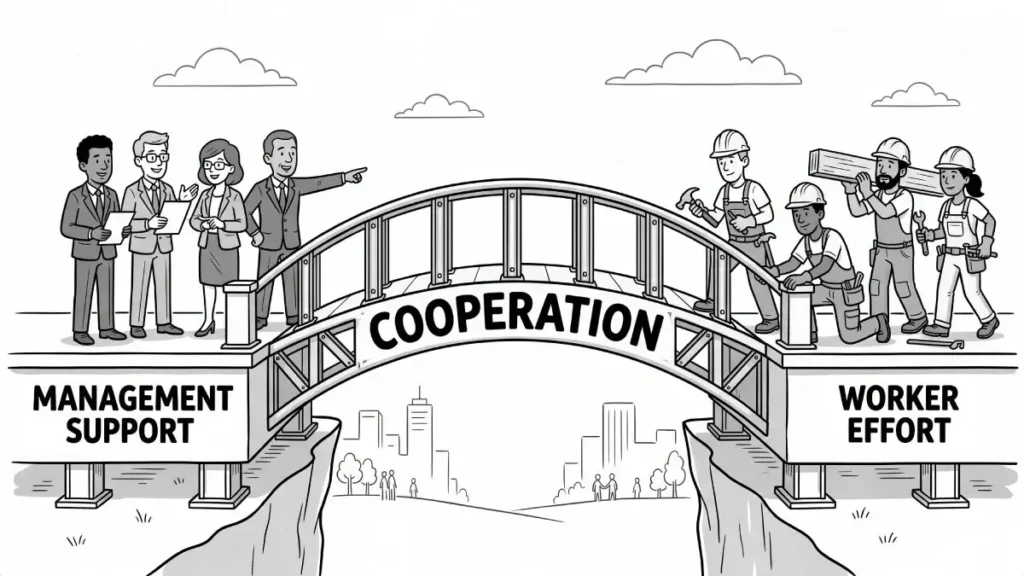
Taylor emphasized Harmony, Not Discord, and Cooperation, Not Individualism. For a workplace to function, there must be a mental revolution where both parties realize their interests are aligned.
Building the Bridge
Cooperation is fostered when management provides the tools and environment for success, and workers provide the effort. This is often achieved through transparency and shared goals.
The Incentive System
To ensure Maximum, Not Restricted Output, modern firms use performance-based pay.
- Bonuses: Tying financial rewards to exceeding KPIs.
- Profit Sharing: Giving employees a stake in the company’s efficiency gains.
- Recognition: Using Gamification (leaderboards, badges) to encourage healthy competition.
4. Division of Work and Responsibility
In the Taylorist model, there is a clear distinction between those who plan and those who execute. This prevents “soldiering” (workers intentionally working slowly) and ensures that specialists are focusing on what they do best.
Management’s Role (The Brain)
- Planning: Setting long-term goals and daily schedules.
- Observation: Monitoring data dashboards to catch bottlenecks.
- Optimization: Constantly refining the “science” of the work.
Workers’ Role (The Hands)
- Execution: Focusing 100% on the task at hand without the distraction of administrative planning.
- Feedback: Providing ground-level data to help management refine the process.
Modern Case Studies: Taylorism in the 21st Century
1. Software Development (Agile & Scrum)
While Agile seems flexible, it is highly scientific. The “Daily Stand-up” is a method to analyze work daily. Sprints are essentially time-and-motion studies applied to code, ensuring a constant, predictable output.
2. Healthcare (Standardized Care Pathways)
Hospitals use “Clinical Pathways” to treat specific ailments. By following a scientifically proven sequence of tests and treatments, they reduce recovery time and minimize medical errors.
3. Retail & E-commerce (Amazon Fulfillment)
Amazon is perhaps the ultimate modern practitioner of Scientific Management. Every movement of a “picker” in the warehouse is tracked, analyzed, and optimized to ensure the fastest possible delivery time.
Benefits and Criticisms
The Pros
- Enhanced Productivity: By removing guesswork, output often doubles or triples.
- Cost Reduction: Efficiency naturally lowers the cost per unit/task.
- High Wages: Increased productivity allows for higher incentive-based pay.
The Cons
- Mechanization of Humans: Critics argue it turns workers into “cogs in a machine,” leading to burnout.
- Stifled Creativity: Strict SOPs leave little room for frontline innovation.
- Alienation: The rigid division between planning and doing can make workers feel disconnected from the final product.
Conclusion
Applying Scientific Management in the modern era is about finding the balance between Data-Driven Efficiency and Human-Centric Leadership. While we no longer treat people as mere extensions of machines, the core principles of analyzing work, selecting the right talent, and fostering cooperation remain the bedrock of any successful enterprise.
Final Advice: Start small. Choose one repetitive process in your department, analyze it scientifically, eliminate the waste, and watch your productivity soar.
| Metric | Rule of Thumb | Scientific Management |
| Task Completion Time | Variable | Standardized |
| Error Rates | High (5-10%) | Low (<1%) |
| Training Time | Months (Apprenticeship) | Weeks (Standardized) |
| Scalability | Difficult | Highly Scalable |