Leadership and Administration Skills for Nurses
Nursing does not only constitutes a profession but it is the pillar that supports the patient care and health care systems, and the well-being of the community. Today, nurses are not only caregivers but most of them are assuming leadership and administrative roles where they not only head the team but also are custodians of policy and high-quality outcomes.
The modern health facility is not easy since nurses are forced to balance between clinical and managerial duties. Nurses are advised to develop leadership and administration qualities to abandon bedside services. Another outcome of effective leadership is the improvement of nursing evaluation, patient outcomes, and the effective work of a nursing team.
The paper is based on the reasons why nurse leadership is so vital, what skills a leader should have, how economic development of leadership in the person can be achieved as well as how a model like nursfpx can assist a nurse to develop their career.
Table of Contents
Why Leadership Matters in Nursing
Solving the Global Nursing Shortage
The nursing workforce is ever-increasing, and the shortage has been a central issue. The issue of staffing shortage in hospitals is well-known throughout the entire world, bringing extra workload, stress, and in some cases, decreasing patient safety as well. Such settings need professional nurse-leaders.
Leaders also ensure that teams are operational, care is always up to date and resources being used are placed well. Their contribution will be in the disparity between the administrative policies and the bedside care to assist the patients and staff.
Beyond Management: The Impact of Leadership
Nursing leadership is not merely having the capacity to assign out shifts or control schedules. It has interests in guiding, motivating and inspiring teams to get to excellence. The results of patient care, employee satisfaction, and healthcare operations are affected by the leader nurses.
When hospitals boast high nursing leadership, there are low occurrences of medical errors, high staff retention and positive patient experiences. Leadership is an instant contribution to the success of employees and patients.
Core Competencies of an Effective Nurse Leader

1. Nursing Evaluation and Clinical Excellence
An effective nurse-leader is a person who is clinically competent, particularly in nursing assessment. Effective evaluation of the patient needs, checking his vital parameters, as well as interpreting the symptoms, are independent competencies which enhance decision-making.
The highest-quality nurses who demonstrate excellent nursing evaluation form the norms of the team, give hope, and ensure that the care guidelines are followed. The foundation of administrative credibility is on clinical competence, which proves that the leadership decisions are founded on patient-centred care.
2. Emotional Intelligence and Communication
The idea of nursing leadership revolves around communication. The leaders should be able to work with multidisciplinary teams, patients and families, which should be understood and explained. Emotional intelligence assists the leaders to eliminate debatable situations, to study the matters of the staff, and to sustain the team.
Good leaders have a listening ear, they give positive feedback and help in the cooperation. They provide an atmosphere in which the workers feel that they are unique, are listened to, and want to do their best as well.
3. Strategic Thinking and Decision-Making
Nurse-leaders should not be incapable of making judgmental decisions that would be in line with the interests of patient care and the organization. It is possible to speak about strategic thinking as the anticipation of issues like patient inflow, staff loss or change of policy.
Recalculating various variables would enable the leader to be proactive, simplify the working process, and achieve great standards of care. The strategic decision-making process will ensure the day-to-day activities are proceeding well and the team is prepared to face the challenges in the future.
4. Staffing Oversight and Resource Management
The nurse-administrators should have an essential resource management skill. The leaders should achieve effective and safe patient care at the intersection of the staffing, workload load and skill mix.
They relax the hiring, recruiting and training and tracking the staff performance and wellbeing. The resources are also effectively utilized in order to curb burnout, morale and continuity of care.
5. Mentoring and Career Development
Giving directions and encouragement to the junior nurses is one of the most crucial qualities of a good nursing leader. The leaders mentor the junior nurses and assess their competence, as well as aid in the career development of junior nurses. They also leave positive feedback, which motivates them to learn more and develop competence.
The nurse-leaders invest in the team and develop the culture of learning, preserve the talents and form the new generation of leaders.
6. Advocacy and Policy Influence
Nurse leaders have their own perception of care of the patient and the needs of the staff. They can affect the change in policy decisions, good staffing ratios, fair compensation, and developmental programs.
The role of influencing the policy with the help of the awareness of organizational goals, regulatory requirements, and healthcare trends is crucial. Effective advocacy will ensure that the outcomes and wellbeing of patients and staff are brought to the forefront.
Real Life Concepts on Becoming a Leader
Improve Clinical Excellence
Continuously enhance nursing assessment. Cultivate reflective practice, seek feedback and be in line with clinical guidelines. Good clinical knowledge leads to credibility and confidence, which are major leadership qualities.
Administrative Experience
Administrative: Volunteer: Bookings, Inventory or Quality Improvement projects. With these possibilities, the problems of operations are learned and help in training the skill of decision-making.
Enhance Soft Skills
Effective leaders must have empathy, communication skills and conflict resolution skills. The skills would be strengthened by attending workshops, peer-based learning, and role-playing. It is also possible to be hurried to grow through watching other experienced leaders, and copying their antics.
Complete Leadership Training
Educate in leadership courses or workshops, or certificate initiatives. Nurse leadership Guide and mentorship structures and resources are available in particular platforms and structures like nursfpx.
Formal education is one that gives confidence, equips nurses with practical tools and conditions them to deal with complex administrative hurdles successfully.
Take Initiative
Volunteer in a committee, special project or mentorship. Being enthusiastic will imply that you are ready to be assigned formal leadership positions and would empower you to demonstrate the understanding of team building and problem-solving competencies.
Tools and Technology in Modern Nursing Leadership
The existing interpretation of leadership in nursing is not limited to the interpersonal, administrative abilities. Modern tools and technology have been found to be very relevant in the management and growth of the team and improving patient care.
Leaders now use electronic health systems to monitor the improvement of the patients, its results, and where they need to make improvements to the care. Some of the primary advantages that digital staffing solutions can cause include the efficient distribution of shifts, the reduction of burnout, and adequate coverage of every unit. E-health systems help in seamless collaboration between nurses and physicians with the other health professionals in the healthcare system, reducing errors and enhancing cooperation. Additionally, evidence-based tools are data-driven with evidence proving to be data-driven to help leaders to analyze trends, evaluate performance levels and make rational and evidence-based decisions.
Use of such technologies also enables nurse-leaders to focus on creating a strategy and creating a team of specialists without reducing the quality of patient care.
Challenges in Nursing Leadership and Topical Challenges and Solutions
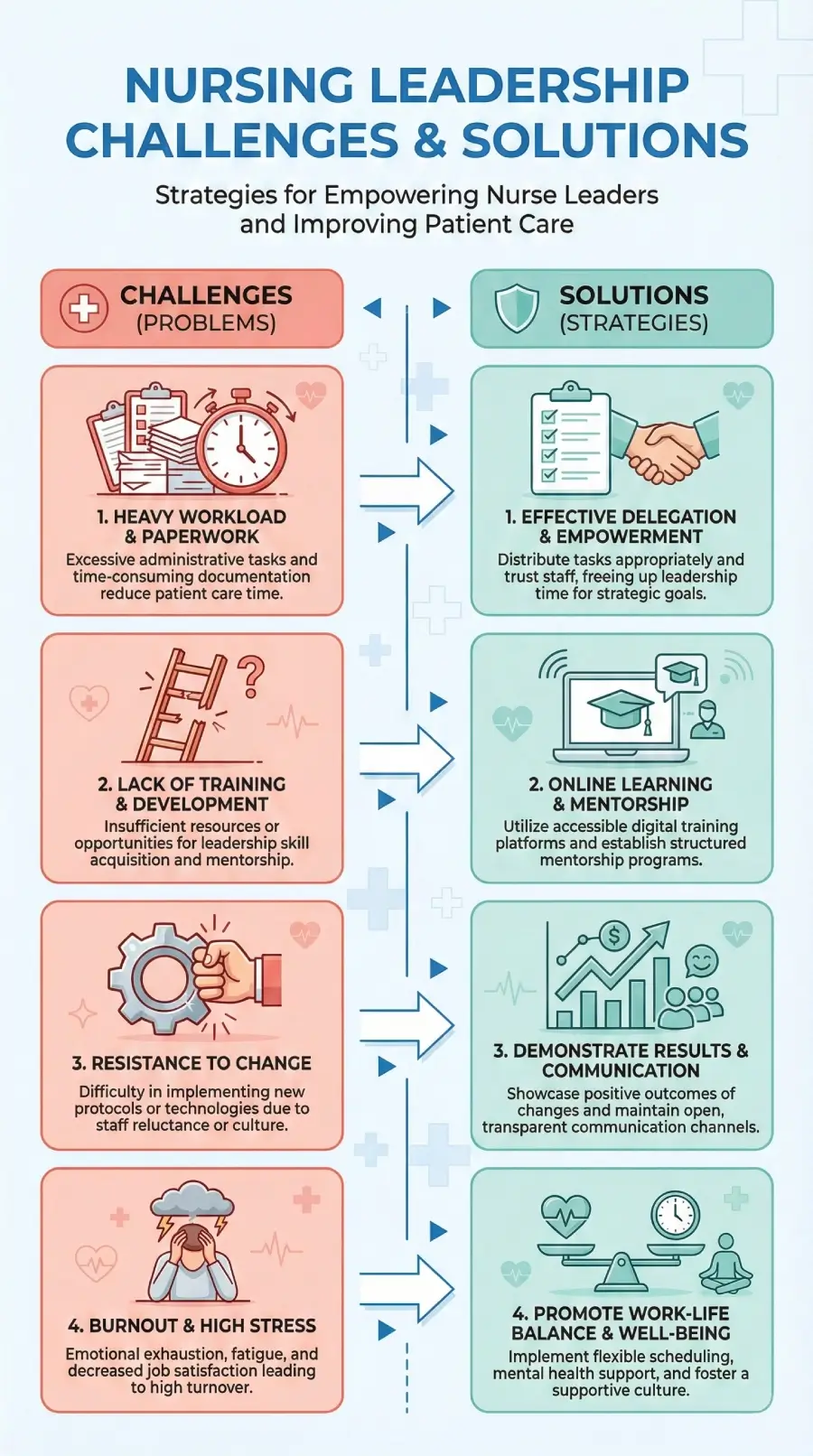
Heavy Workload and Workforce Pressures
The schedules of nurse-leaders are rigorous and packed, and they include both clinical and administrative jobs and this leaves them with insignificant time to grow as experts.
Solution: This should be done by prioritizing the activities, delegating the tasks where essential, and providing a sequence of activities so that patient-related tasks and the tasks related to the leadership could be handled.
Weak Leadership Training Opportunities
Formal leadership skill development programs are not available in some healthcare institutions, particularly in settings constrained by resources.
Solution: Nurses can also pursue online courses, mentorships or even organized programs such as nursfpx so they can work their own way inside the system and become prepared to join higher leadership roles.
Resistance to Change
Some healthcare companies or departments do not consistently agree to enact an initiative or new management pattern by nurses.
Solution: Demonstrate the value of your suggestions through the assistance of objective changes of results of work and employee satisfaction and productivity of work. Success that works also brings about acceptance.
Finding the Balance Between Work and Personal Responsibility
A stressful experience about being involved with leadership and attempting to balance the work between clinical and administrative, without a balance could lead to stress or burnout.
Solution: Develop time management, limit and focus on self care. Sharing of assignments, also establishing achievable goals, come in handy in upholding personal health as one undertakes the task at hand.
Impacts of Nurse Leadership in Practice
Select a hospital unit that is identified with high turnover and staff burnout. Such leaders have implemented mentorship programs run by nurses, there is better communication among employees and has provided flexible working schedules. They also became better in the patient satisfaction score, staff retention and minimization of medical errors in six months.
This scenario demonstrates that proper leadership is not just a fantasy but direct output to the patient, employee happiness and operations productivity. Clinical excellence, efficient nursing appraisal and team creation create quantifiable positive change by leaders.
Become a Nurse Leader Roadmap
Master clinical competencies and nursing assessment.
- Observe and learn how good leaders behave.
- Develop tender skills, e.g. communication and emotional intelligence.
- Request formal education and implement theories like nursfpx.
- Participate voluntarily in small leadership undertakings and committees.
- Empower the policy amendments and staff development initiatives.
- Stop, revamp, and never-ending improvement in the leadership.
This roadmap will allow nurses to freely transition out of the bedside services to the administrative services and leadership positions.
Conclusion
The demand for skilled leaders in nursing has never been higher. Developing leadership and management abilities that are founded on clinical knowledge, leadership, and mentorship enhances patient care, team-building of healthcare and efficiency of the system.
These frameworks, such as nursfpx, provide a guideline, structure and direction to all the nurses on the journey between the boardroom to the bedside and vice versa. Nowadays, by investing in leadership skills, nurses can create the future under which leadership will become an inseparable part of the profession and will transform the lives of patients, the members of staff, and the healthcare organizations positively.
Nursing leadership is not a ruling, but a care, vision and life enhancement. Any nurse may become a leader, an inspiration and a massive contribution.