Types of Entrepreneurship with Examples – Best 26 Categories
Recently, the Global Entrepreneurship Monitor (GEM) has surveyed 65 economies through the Adult Population Survey (APS). It announced that there are more than 582 million entrepreneurs in the world. That means one in every thirteen people owns a business! So, we can say that entrepreneurship exists everywhere. Yet, most people fail to explain how it does. However, this article describes what entrepreneurship is, the different types of entrepreneurship with examples, and its related important topics.
Table of Contents
What is Entrepreneurship?
Entrepreneurship is the process of launching, running, developing, and designing a new business. It is often at the start of a small business. In simple terms, entrepreneurship is the willingness to launch a new business venture. The people who do such businesses are called entrepreneurs.
It is not an easy task because 90% of startups fail each year. Nevertheless, more and more people pick to be independent in their professional careers. According to Deal Sunny, 2 out of 3 individuals think it is a decent choice.
Types of Entrepreneurship:
Most people think that entrepreneurship has just a single meaning. But there are different kinds of entrepreneurship. Steve Blank teaches customer development and secret history at Stanford, Berkeley, and Columbia in the USA. He wrote an article named Startup America – Dead on Arrival. In this article, he described the four types of entrepreneurship. Such as:-
- Small Business Entrepreneurship
- Scalable Startup Entrepreneurship
- Large Company Entrepreneurship
- Social Entrepreneurship
A. Small Business Entrepreneurship:
At present, the number of entrepreneurs and startups overwhelms the USA with different kinds of entrepreneurship. Of these, 5.7 million are small businesses. They generate 99.7% of all companies and employ 50% of all non-governmental employees.
They make up barely any profits. With these profits, they live and support their families. These businesses are too small to attract venture capital; they rely on family, friends, or small business loans.
Examples of small businesses include grocery shops, small industrial cottage businesses, consultants, hairdresser parlours, travel agents, electricians, carpenters, etc.
B. Scalable Startup Entrepreneurship:
These entrepreneurs have dreams to change the world. Venture capitalists assist financially in this business. They find expert and skilled people as employees. Every step is based on a repeatable and scalable business model. Scalable startups make up a small percentage of startups. On account of the massive earnings, they attract almost all the risk capital.
Examples of scalable startup entrepreneurship are Instagram, Facebook, Online shopping for electronics, etc.
C. Large Company Entrepreneurship:
Through offering new products and sustaining innovation, these companies vary around their core product. When they launch a new product in the market, it must be given importance to customer needs and demands and advanced technology. Often, we recognise that these types of companies do this by partnering with or buying innovative companies.
Examples of large company entrepreneurship include Microsoft, Google, Samsung, BMW, etc.
D. Social Entrepreneurship:
Social entrepreneurs are real innovators. They create products and services that solve social needs and problems. Their main focus is to keep the world safe. Profit maximisation is not their theme. These categories of entrepreneurship may be non-profit, profit, or hybrid.
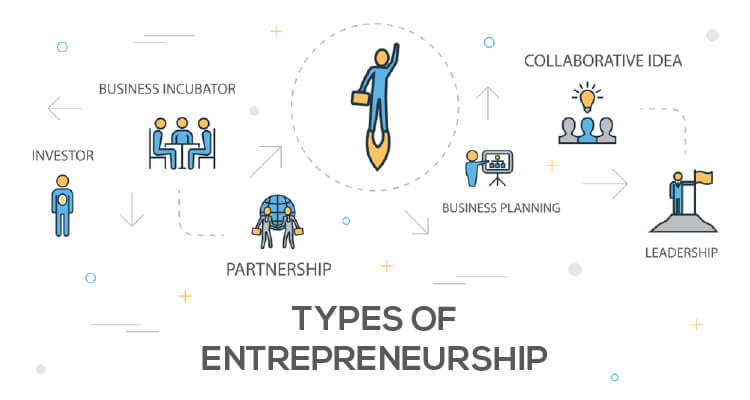
Technical Perspective Entrepreneurship Types:
We have already stated that not all entrepreneurship is the same. So we can categorise. Differently, we will get 6 kinds of entrepreneurship from a technical perspective. For example:-
1. Intrapreneurship:
Firstly, Gifford Pinchot first introduced us to the intra-corporate entrepreneur in 1973. It was later revised to intrapreneur. In 1992, this term was officially recognised. Additionally, the American Heritage Dictionary provided a definition. Accordingly, a person who belongs to a large corporation and takes direct responsibility for profit maximisation through assertive risk-taking and innovation is called an intrapreneur. Four elements are required to establish successful intrapreneurship. Such as:-
- The right strategic and structural environment within the organisation
- Talented, skilled, trained, and motivated workforce recognised
- Ensured Collaboration and natural networking among employees
- Available rewards and penalty tools
2. Technopreneurship:
Secondly, if we break the Tehnopreneurship term, we can find two separate words: one, technology, and another, entrepreneurship. It is a synthesis process in engineering the future of a person, a group, an organisation, an ethnicity, a nation, and the world. An entrepreneur takes his all-action, technology-based. It is called technopreneurship. It has some features. Such as:-
- Employment generating
- Best use of local resources
- Decentralised and diversified business
- Promoting technology
- Capital forming
- Promoting an entrepreneurial culture.
3. Transpreneurship:
Thirdly, when transgender and Hijra come up with some small businesses to improve their lives, it is called transpreneurship. It operates with the third gender, which does not include beggars or sex workers.
Anam Prem of Mumbai in India is a well-known example of transpreneurship.
4. Netpreneurship:
Fourthly, Cyberpreneurship and E-Entrepreneurship are alternative names for Netpreneurship. According to the Longman Dictionary of Contemporary English, a netpreneur is an individual who delivers products and services after creating them through online mode.
5. Agripreneurship:
Fifthly, Agriculture, and Entrepreneurship; these two words make up agripreneurship. It is an agriculture-based concept that covers turning an idea or vision into a new business.
Plant Clinics, Spin Farming, Herbal Processing Units, and Rantachook are also examples of agripreneurship.
6. Ecopreneurship:
Sixthly, Green Entrepreneurship and environmental entrepreneurship are other names for ecopreneurship. It is such ecopreneurship that is of interest from an environmentally responsible perspective. David Kainrath has categorised three forms of entrepreneurship (ecopreneurship), including:
- Eco-innovation
- Eco-opportunity
- Eco-commitment
Place Perspective Categories of Entrepreneurship:
From the place perspective, we can find different kinds of entrepreneurship. Here are three types. Such as:-
1. Domestic Entrepreneurship:
In the domestic entrepreneurship of entrepreneurship forms, the entrepreneur creates goods and delivers services within a specific nation or country. They have to follow all existing rules and regulations of that government.
For example, Dog Walking, Freelancing, House Cleaning writing, etc.
2. State Entrepreneurship:
In the types of entrepreneurship, state entrepreneurship operates and manages the whole government of the state. Only state; not a single entrepreneur undertakes all industrial ventures as well as trading.
For example, any state-based business like Investpunjab in India.
3. International Entrepreneurship:
Of the varieties of entrepreneurship, international entrepreneurship is the most attractive one. When an entrepreneur’s conducting business activities across national boundaries, it is called international entrepreneurship. There are given some importance to international entrepreneurship. For example:-
- Increasing sales and profit
- Utilizing the Talent and Managerial Competence
- Opportunity creation
- Developing an image of the company
- Enriching quality of product
More Categories of Entrepreneurship:
We have already described the number of entrepreneurship types. There are mentioned some more categories of entrepreneurship. Such as:-
1. Administrative Entrepreneurship:
Under this category, all administrative functions and initiatives include. It is a very effective process to enhance future competitive and merit edge.
The old-age pension scheme for government officials or employees is the best example of it.
2. Opportunistic Entrepreneurship:
At the right time, an entrepreneur has to make the right decision. This way, an opportunistic entrepreneur ensures identifying, exploiting, and performing the upcoming opportunities. So, it is given extra priority in other types of entrepreneurship.
FedEx, Lan Hancock, Arthur Fry, etc. are well-known examples of it.
3. Incubative Entrepreneurship:
Here, nurses generate new ventures and ideas within the organization. It manages a productive way and ensures material gain for the business firm.
To exemplify, Nokia and Microsft always promote and discover their own new technologies in a wide range of services and products among all services in the marketplace.
4. Imitative Entrepreneurship:
Has an alternative name that is Adoptive Entrepreneurship. Here, the entrepreneur adopts an earlier product from another country or nation but is new in that particular region or country.
For instance, China’s mobile technologies adapt and modify to take this to a new level.
5. Cultural Entrepreneurship:
Cultural entrepreneurship is an important one in the types of entrepreneurship. Here, entrepreneurs are visionaries and cultural change agents who develop financial, social, cultural, and human capital to generate returns from cultural doings. Examples of cultural entrepreneurs are writers, artists, musicians, dancers, actors, advertisers, and newer TV/music producers, game developers, graphic designers, and bloggers.
Others Entrepreneurship
Besides these entrepreneurship types, we can categorize entrepreneurship in different ways—for instance, demographic types, economic types, ethical types, etc. However, there are mentioned more names of such entrepreneurship types. Such as:-
- Public Entrepreneurship: Public entrepreneurship is the process by which new ideas are generated and implemented in the public sector.
- Private Entrepreneurship: The private entrepreneur is the simplest and lightest company form. As a private entrepreneur, you can engage in business activities alone, with your spouse, or with your children and grandchildren under the age of eighteen.
- Individual Entrepreneurship: In individual entrepreneurship, a business is conducted by one person who has ownership over his property and the proper rights to use and dispose of it in order to start a business.
- Mass Entrepreneurship: Mass entrepreneurship refers to the millions of small businesses that exist in every community, meeting local needs with local resources.
- Acquisitive Entrepreneurship: Entrepreneurship involves acquiring wealth or reaching your competitors’ level of competence. This characteristic helps entrepreneurs succeed in a highly competitive environment.
- Joint Entrepreneurship: The collaboration of a group of people who jointly take on the risks and responsibilities of ownership and management of a business is called joint entrepreneurship.
- Trading Entrepreneurship: A trading entrepreneur provides a service by searching for new markets, stimulating demand for his product line, and creating a desire and interest among buyers to go in for that product. He trades both domestically and overseas.
- Commercial Entrepreneurship: Commercial entrepreneurship is where an entrepreneur uses private capital to engage in market-based exchanges, with the intention of making money.
Buy these books to get more information:
Suppose you want more information about the entrepreneur. You have to read more things. Because this article is not enough to absorb the whole concept, you can see that The Lean Startup: How Today’s Entrepreneurs Use Continuous Innovation to Create Radically Successful Businesses is an excellent book. It is written by Eric Ries (Who is an entrepreneur and author of the popular blog Startup Lessons Learned). The book has been praised in the New York Times, the Harvard Business Review, the Wall Street Journal, the Huffington Post, and different trusted blogs.



Hello There. I found your blog using MSN. This is a really well-written article. I will be sure to bookmark it and come back to read more of your useful information. Thanks for the post. I’ll definitely comeback.
Entirepreship is the buzzword. For globalization, we almost know about this; although maximum people feel wrong. However your this article is really valuable.
Pretty! This was an incredibly wonderful article. Thank you for providing this information.
Very nice blog post. I certainly love this website. Keep writing!