Difference Between Forecasting and Prediction
Difference Between Forecasting and Prediction: The Ultimate Practical Guide
When planning for tomorrow, two terms frequently appear side by side: forecasting and prediction. While everyday conversation often treats them as identical twins, in statistics, data science, economics, and business management, they serve distinct purposes.
Confusing a forecast with a prediction can lead to misallocated budgets, flawed supply chains, and poor strategic bets. Understanding the exact difference between forecasting and prediction ensures decisions rely on mathematical rigor rather than mere intuition.
Table of Contents
What Is Forecasting?
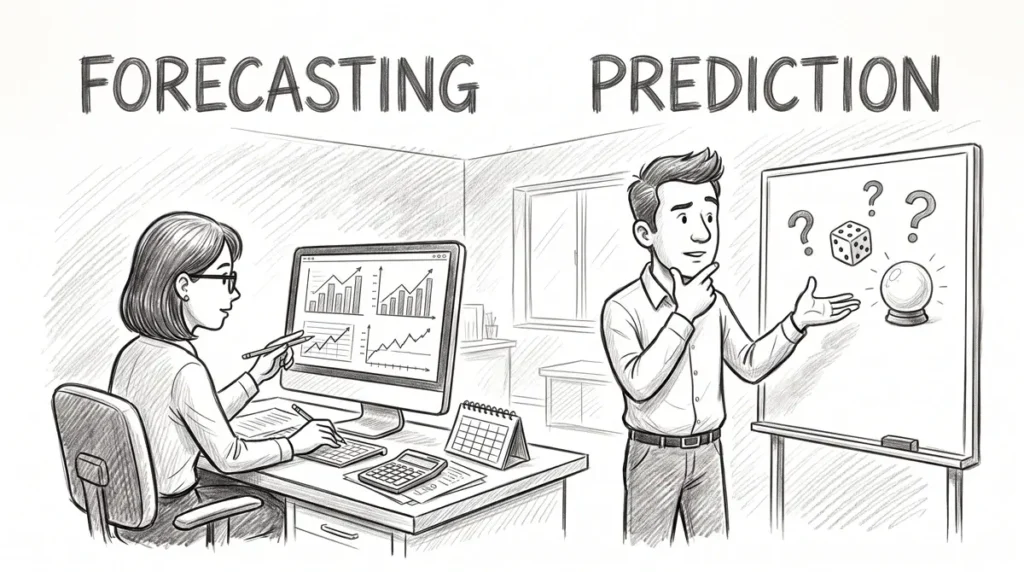
Forecasting is the systematic, objective process of estimating future events by projecting historical time-series data forward through mathematical, statistical, or machine learning models.
The word itself originates from the concept of “throwing ahead”—taking patterns that have already unfolded and mathematically extending them across a timeline.
How Forecasting Operates
A credible forecast does not rely on a hunch. It follows a structured four-stage data pipeline:
- Historical Data Gathering: Collecting clean, chronologically organized observations (e.g., monthly sales totals over 36 months).
- Trend and Seasonality Decomposition: Isolating baseline movement, periodic cycles (e.g., holiday sales spikes), and irregular variance.
- Model Selection: Running algorithms such as ARIMA (AutoRegressive Integrated Moving Average), Exponential Smoothing (ETS), or Prophet.
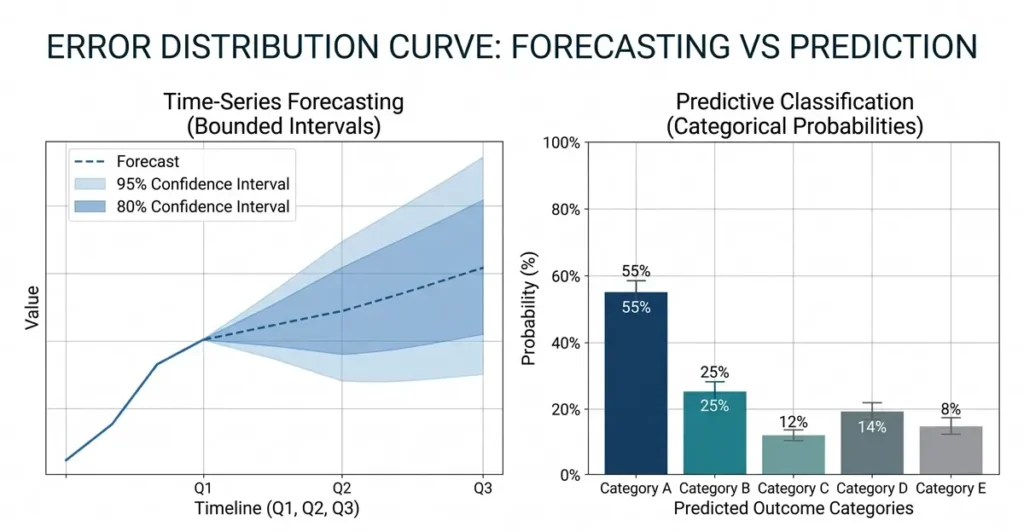
- Confidence Interval Calculation: Producing a specific expected range with measurable probability margins (e.g., 95% confidence intervals).
Forecasting tools are generally divided into two main categories:
- Quantitative Forecasting: Relies strictly on numerical data, leveraging time-series analysis, econometric models, and causal frameworks.
- Qualitative Forecasting: Leverages structured expert judgment (such as the Delphi Method or market consensus panels) when past data is sparse or disrupted by black-swan events.
What Is Prediction?
Prediction is a declaration or estimate about an outcome that may happen in the future, or an unknown state of nature, made using subjective experience, heuristics, qualitative signs, or cross-sectional algorithms.
Etymologically, the term stems from the Latin “praedicere”, meaning “to say beforehand” (pre = before; diction = utterance). While a prediction can incorporate rich data and sophisticated classification trees (like Random Forests or Neural Networks), it does not strictly depend on chronologically ordered historical series. Predictions can be made off-the-cuff by an experienced manager, or output by an AI engine classifying whether a customer will churn tomorrow based on current demographic traits.
Key Characteristics of Predictions
- Subjective and Intuitive Flexibility: It can synthesize gut instinct, street intelligence, and qualitative sentiment.
- Broad Temporal Horizon: Predictions can address immediate events (“Who will win tonight’s match?”) or deep-future scenarios (“Will quantum computing break RSA encryption by 2040?”).
- Point-in-Time Outputs: Predictions frequently yield categorical statements (Yes/No, Win/Loss) or probability distributions without demanding a continuous historical timeline.
Comparison Table: Forecasting vs Prediction
To immediately scan the core trade-offs between both methodologies, review this structured comparison breakdown:
| DIMENSION | FORECASTING | PRETICTION |
| Primary Definition | Projecting historical time-series data systematically into the future | Stating a prospective outcome based on intuition, signals, or non-temporal models |
| Foundational Concept | “Throwing ahead” past trends along a timeline | “Saying ahead” what outcome will emerge |
| Core Input | Chronological past records, seasonal cycles, trend components | Subjective judgment, expert instinct, static features, or observed cues |
| Degree of Objectivity | High; statistical models yield identical outputs from identical datasets | Variable; often influenced by cognitive bias, heuristics, or personal beliefs |
| Error Measurability | Highly measurable (MAPE, RMSE, MAE, MAD) | Harder to quantify systematically, especially for one-off events |
| Time Orientation | Strictly sequential time horizon (short, medium, or long-term periods) | Independent of sequence; covers specific events or states regardless of time gaps |
| Replicability | Replicable across data analysts applying the same model | Often unique to the observer, expert panel, or specific model run |
| Typical Business Use | Inventory sizing, cash-flow runaways, raw-material purchasing | Strategic pivots, competitive reactions, macro market disruptions |
Learn More: Human Resource Management vs. Personal Management
In-Depth Analysis: The Key Distinctions
When examining prediction vs forecasting, several structural elements separate the two disciplines:
1. Data Dependency and Structure
Forecasting requires a continuous historical sequence. If you remove the timestamps from a forecasting dataset, the analysis breaks down completely.
In contrast, prediction can occur with zero prior numbers (e.g., predicting an election upset based on door-to-door crowd energy) or with static tabular features where order does not matter (e.g., predicting loan defaults based on credit score, income, and age).
2. Error Tracking and Model Validation
In forecasting, performance is constantly checked against mathematical reality via backtesting:
- Mean Absolute Percentage Error (MAPE)
- Root Mean Squared Error (RMSE)
- Mean Absolute Deviation (MAD)
If a supply-chain demand forecast misses by 8%, operators can diagnose whether the error stemmed from trend miscalculation or an unexpected exogenous shock.
For predictions, especially categorical or unique singular events (e.g., “Will company X acquire startup Y this year?”), validating error metrics prior to the event is rarely feasible.
3. Business Impact and Operational Value
In corporate governance:
- Forecasting answers operational questions: “How many customer service reps do we need on Monday morning?” or “How many metric tons of steel must we order for Q3 production?”
- Prediction answers strategic or qualitative questions: “Will consumer preferences shift away from internal combustion vehicles faster than regulations mandate?”
Learn More: Similarities & Differences between Occupation and Profession
Real-World Examples: Side-by-Side
To eliminate ambiguity between forecasting vs prediction, review how both apply across everyday sectors:
| Industry | Forecasting Scenario | Prediction Scenario |
| Retail & E-Commerce | Projecting next quarter’s SKU-level inventory demand based on past 3-year point-of-sale records | Predicting whether an individual shopper visiting the homepage will click the checkout button |
| Meteorology & Sports | Tracking barometric pressure, wind currents, and Doppler radar to forecast precipitation over 48 hours | Predicting which team will lift the championship trophy at the end of the season |
| Finance & Investment | Modeling a company’s free cash flow over the next 5 fiscal years using quarterly financial reports | Predicting whether a sudden regulatory announcement will trigger a market crash next week |
| Healthcare | Forecasting hospital ICU bed occupancy rates over the winter influenza season | Predicting whether a patient with specific genetic biomarkers will respond favorably to an immunotherapy drug |
Learn More: Difference between Society and Community
Choosing Between Prediction and Forecasting
Selecting the correct approach depends on available assets, constraints, and operational goals. Use this decision rule:
- Choose Forecasting when:
- You hold clean, reliable historical data logged at regular time intervals.
- The underlying process shows visible seasonality, trends, or cyclic behavior.
- You need to deliver concrete quantitative ranges with defined statistical margins of error.
- The primary objective is resource planning, inventory procurement, or budget baseline creation.
- Choose Prediction when:
- You are assessing a novel, unprecedented scenario where past metrics do not exist.
- The output is a binary or categorical choice (Yes/No, Default/Pay, Churn/Retain).
- Qualitative factors, psychological sentiment, and strategic intuition outweigh mechanical extrapolation.
- You are working with cross-sectional datasets without chronological dependencies.
Learn More: Real Estate Agent vs. Real Estate Broker
Strategic Synthesis
Understanding the exact boundary between forecasting and prediction is essential for effective data-driven decision-making.
Forecasting anchors planning to historical empirical evidence, giving organizations the objective baselines needed to balance capacity, supply, and cash flow. Prediction provides the creative and inferential leap necessary to anticipate disruptions, assess one-off anomalies, and navigate an unpredictable world.
High-performing leadership teams do not choose one over the other. Instead, they use rigorous statistical forecasts to establish their operational foundation, while deploying targeted predictions to seize emerging market opportunities.